Risk and reward become a design system when the player can choose between meaningful alternatives. A dungeon that simply gets harder over time has difficulty, but may not give the player much control over their exposure. Optional risk asks a more interesting question: what am I willing to attempt, and what makes that attempt worthwhile?
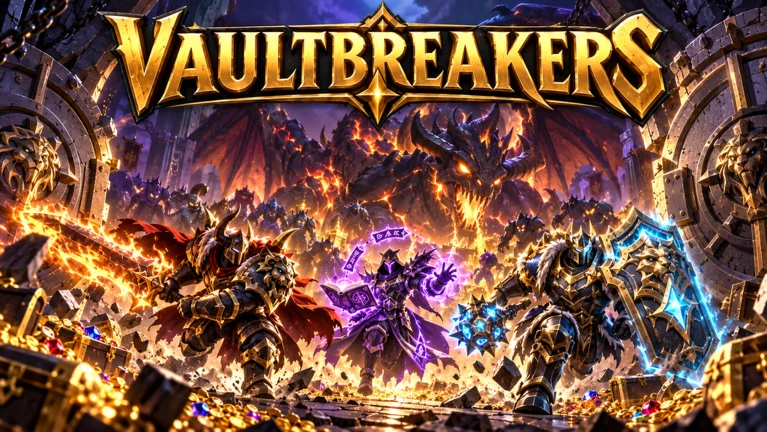
Vaultbreakers is a playable alpha with dungeon exploration, gear, spells, bosses, and a Heat system described as changing difficulty and rewards. It supports solo play or a group with up to two friends. This guide uses that premise as a reference for decision design, without claiming exact Heat values, drop rates, or a completed balance model.
Show the decision before the commitment
A player should know when they are choosing extra risk. Place the explanation at the point where they can still compare alternatives. If the consequences appear only after a run starts, the choice feels accidental. A clear commitment point makes both success and failure easier to interpret.
Explain the kind of cost, not merely a larger number. More dangerous encounters, tighter recovery, or changed enemy behavior are different forms of difficulty. The actual system may use one or several, but the player needs a useful description of what to prepare for.
Keep the interface concise while offering detail where it helps. A short summary can support a quick choice, with an optional explanation for someone planning a run. The same structure helps returning players remember the system. They should not need to rediscover the meaning of an important setting each time they resume the game after a break.
Connect reward to the reason for taking risk
The reward should make sense relative to the extra demand. If risk requires careful planning, an outcome that supports future planning can feel connected. If it asks for mastery of combat, progress toward a combat goal may be appropriate. These are design relationships, not claims about specific Vaultbreakers rewards.
Avoid treating reward as only a quantity multiplier. A greater amount can be useful, but access, variety, or a more interesting choice can also motivate an attempt. Decide what the player is trying to accomplish before making every reward larger.
Show what can reasonably be expected without guaranteeing an uncertain result. Players should distinguish a known benefit from a possible drop. Confusing those categories can create disappointment unrelated to the intended difficulty. Mystery fishing progression addresses a comparable distinction: uncertainty about discoveries can be enjoyable when the process and goals remain understandable.
Preserve a useful learning run
The lower-risk path should still be a real version of the game. If it removes every meaningful mechanic, it may fail to teach what the higher-risk version expects. Introduce the important decisions with enough room to recover and observe the consequences.
Let players establish a baseline. They need to understand what their current equipment and abilities can do before evaluating an optional increase in difficulty. An early run that changes several rules without explanation makes the comparison hard to interpret.
Observe what players carry from the learning run into the next attempt. Do they recognize a warning? Do they plan around a resource? Do they change a route? Those are useful signs that the lower-risk path taught something transferable. Actionable playtesting can identify whether failure on the harder run comes from a new challenge or a missing explanation of the original rules.
Balance the group decision
A cooperative party may contain players with different experience and goals. The risk selection should make clear who is committing and whether everyone understands the setting. A visible summary near the start can support that conversation without requiring a complex voting system.
Check whether the extra risk affects every participant in a way they can perceive. A veteran may handle the dangerous task while a newcomer sees little change except longer encounters. That may be appropriate for some group styles, but it should be an intentional result rather than an unnoticed side effect.
Review rewards from each participant’s perspective. Group contribution and individual progression can interact in complicated ways. The principles in shared boss participation design are useful here: define what participation means and show feedback that survives a crowded encounter. A group should be able to explain why the run was worthwhile for its members.
Keep equipment choices interpretable
Gear and spells create preparation decisions only when their effects are understandable. A long list of statistics can obscure the practical difference between two options. Offer enough context for the player to predict a change in play, while preserving room for experimentation and mastery.
Make the current selection visible before the run. A player should know what they are bringing and what might need adjustment for the chosen risk. The interface can connect preparation to the expected challenge rather than treating equipment as an isolated inventory task.
Avoid changing several unrelated values merely to make a new difficulty tier feel different. If players cannot identify which change matters, they may rely on a single remembered build instead of exploring choices. A focused variation is easier to understand and test. It also helps a solo developer investigate whether the system is producing the intended decisions without an overwhelming number of combinations.
Make failure explain the next attempt
Failure should leave information. The player might learn that a resource ran out, a warning was ignored, or the selected route exposed the group too long. Useful feedback connects the end of the run to a decision the player can change.
Separate the consequences of failure from the explanation. Losing progress can fit a high-risk system, but it does not itself teach what happened. A concise run summary or clearly observed final encounter can help the player form a plan for another attempt.
Consider recovery outside the dungeon too. How quickly can the group review, adjust, and start again? An unnecessary sequence of menus can make the next run feel costly even when the intended risk is inside the dungeon. Replayability system planning looks at this broader loop: repeated attempts need meaningful variation and a practical path back to action.
Audit the system with explicit comparisons
Choose two risk settings and describe the expected difference before testing them. Record the decisions that should change, the feedback that communicates the difference, and the reason a player would choose each setting. If you cannot name a reason for the lower setting beyond inexperience, it may need a clearer role.
Test the comparison with the same basic route or encounter so unrelated variation does not hide the result. Then test different equipment and party situations. The purpose is not to make every combination equally successful. It is to see whether players can interpret the stakes and make useful adjustments.
For an alpha project such as Vaultbreakers, communicate that tuning can evolve. Accurate status belongs on the game page, while a design guide can explain the underlying decision structure. A risk system is strongest when players can tell why they chose the challenge, what happened during it, and what they might do differently next time.
Compare choices in preparation
Give a tester two possible run settings and ask them to explain why they would choose each before starting. Their explanation reveals whether the interface communicates a real tradeoff. If both are described only as “the same run, but longer,” the reward or challenge relationship may need clearer definition.
After the run, ask which preparation decision mattered most. Compare that answer with the intended design. A player who cannot connect the outcome to any choice may need better feedback, not simply a different numerical balance. This before-and-after comparison is useful because it tests the meaning of the decision as well as the difficulty of the encounter.