Cooperative horror becomes more interesting when players understand enough to make a choice, but cannot predict every outcome. Sound is useful because it reaches beyond the camera. A footstep behind a wall can change a route before a creature appears. The challenge is to make that information usable without removing uncertainty. This guide examines sound as a rule, a warning, and a coordination tool rather than simply a collection of frightening effects.
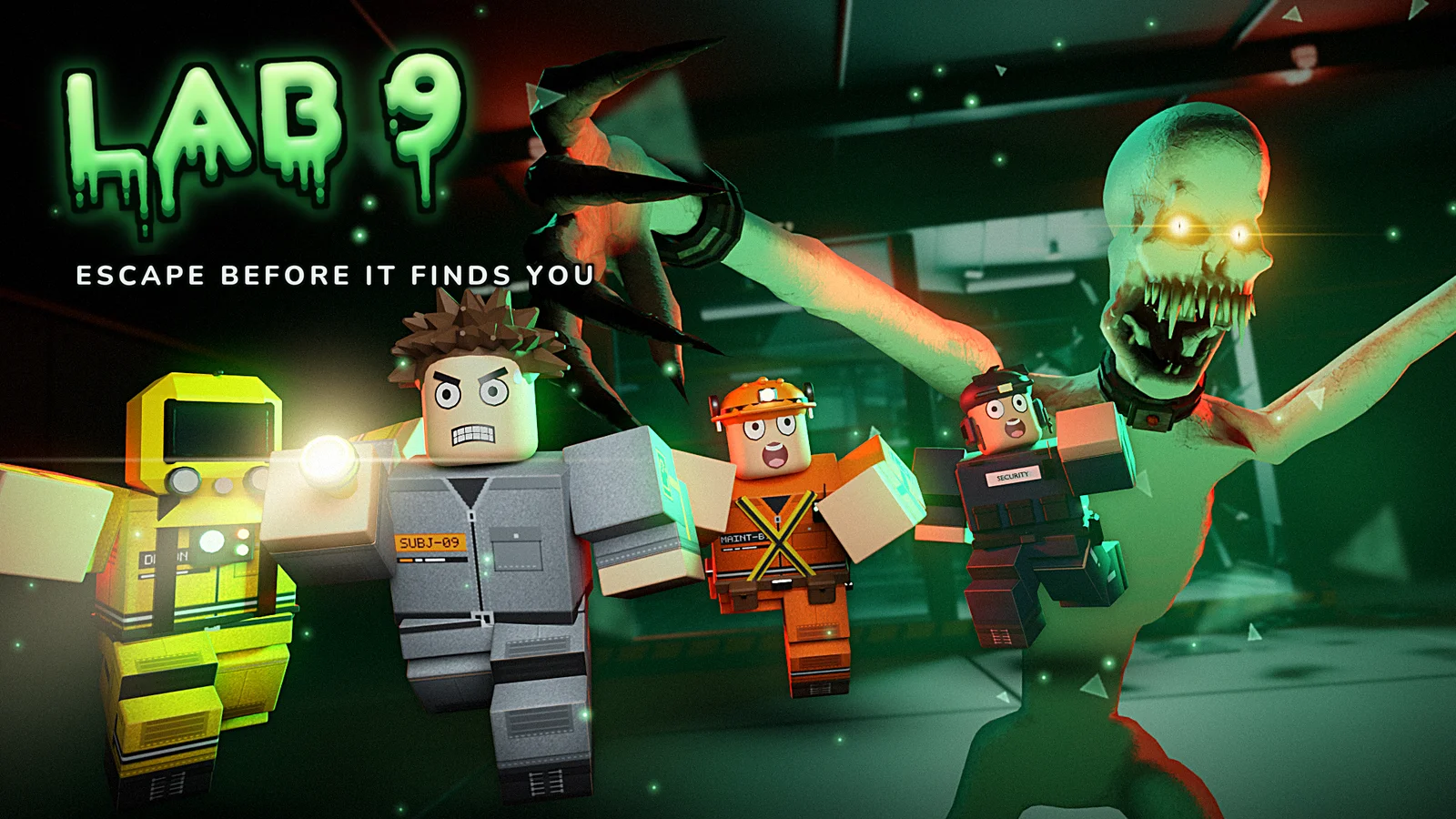
Lab 9 provides a reference: its public premise includes a specimen that reacts to sound, solo play or a group of up to four, and several escape routes. The recommendations below are design approaches for that kind of experience, rather than claims about undocumented implementation details inside the game.
Establish a sound rule players can learn
A sound-sensitive threat needs a consistent relationship between an action and a consequence. If opening a door sometimes attracts danger, players need some way to understand what changed. Distance, the material of the door, the creature’s position, or a special event might explain the difference. Random punishment with no readable cause gives players little reason to adjust their behavior. Mystery works better when the rule is learnable and the exact situation remains uncertain.
Introduce the relationship in a space where the consequence is recoverable. A loose object could make a noise, followed by an unmistakable response somewhere nearby. The player can observe the response without immediately losing the run. This creates a small experiment: action, signal, reaction. A tutorial message may support that experiment, but the environment should make sense when the message is missed.
Write the intended rule in ordinary language before choosing effects. For example, “moving quickly creates a larger detectable sound than walking” is a testable statement. “Make movement scary” is not. The clearer statement gives animation, audio, environment, and playtesting a shared target.
Separate information from atmosphere
Ambient machinery, wind, electrical hum, and distant impacts can establish a place. They should not compete equally with an important warning. Give actionable sounds a recognizable character: a particular rhythm, a distinct frequency range, or a consistent direction. A player should notice that a meaningful event happened without memorizing an enormous catalogue of effects.
Layering matters. If a loud ambient loop hides every footstep, players may conclude that the threat behaves arbitrarily. If the important cue always cuts through at full volume, the result can become exhausting. Consider a hierarchy in which nearby consequences are clearer than decorative ambience, while distant activity remains less certain. The hierarchy supports judgment instead of treating all sound as decoration.
Information should have alternatives. A visual reaction, environmental change, or optional caption can support a cue without explaining the entire threat. Players have different listening conditions, including small speakers and noisy rooms. Reduced-motion and accessible interaction design addresses a related principle: preserve useful meaning when one presentation channel is unavailable.
Give quiet behavior a meaningful cost
If silence is always the safest and fastest option, a sound mechanic may produce one obvious strategy. Better tension comes from competing needs. Quiet movement might take longer. A necessary interaction might create a predictable disturbance. A faster route might pass through an exposed room. The player weighs the cost of waiting against the cost of being noticed.
The cost does not need to be a countdown. It can be an opportunity, a teammate waiting in a dangerous location, or a resource needed elsewhere. Players need to understand why they might choose something risky. A choice feels stronger when its consequences are visible before the commitment, even if the final result is uncertain.
Avoid making every interaction equally noisy. Give players a vocabulary of actions they can compare. A slow door opening, a dropped object, and a rushed sprint can create different problems. Those differences make the environment feel usable. They also provide material for replayability through changing decisions rather than adding more corridors alone.
Design communication into cooperative spaces
A cooperative horror map should let teammates exchange useful observations. One player might see a corridor while another hears something beyond it. A junction with a safe observation point can encourage a short conversation about the next move. A sequence of identical doors gives the group fewer meaningful things to report.
Consider how separated players recover shared context. Room landmarks, distinct silhouettes, and clear route names are easier to communicate than “the room with another shelf.” The environment helps players describe their situation without opening a large map or stopping the tension. This is valuable when the team is deciding whether to regroup or continue an escape attempt.
Communication creates difficulty too. A group may act before everyone understands the plan. Design consequences around the actual game actions rather than assuming players use a particular external voice service. Solo players need equivalent ways to gather necessary information. The number of people should change coordination demands, not make a basic clue impossible to obtain alone.
Make escape routes support different judgments
Multiple exits become interesting when they ask different questions. One might require a long preparation phase; another could involve a dangerous final approach. Even when routes share some objects, their demands should be legible enough for a group to form a plan. Cosmetic variation alone rarely changes the experience of choosing.
In a sound-driven design, ask how each route uses noise differently. Does it encourage careful movement, a deliberate distraction, or a coordinated rush? These are hypothetical possibilities, not descriptions of specific Lab 9 escape procedures. Connect the escape objective to the threat’s central rule instead of treating the objective as an unrelated checklist.
Make the commitment point visible. Players should know when they are changing plans, consuming a useful item, or opening a risky area. Dungeon risk and reward design explores the same decision structure in another genre: stakes are more satisfying when the player can identify the choice that created them.
Test the quiet moments, not just the chase
A chase produces obvious feedback. Quiet exploration can fail more subtly. Watch whether players stop because they are making a decision or because they cannot understand what to do. Ask afterward what they believed the threat could hear. If their explanation differs from the intended rule, inspect the sequence that taught that belief.
Record concrete observations: the first noise a player noticed, the route they changed after hearing it, and the warning they missed. These details are more actionable than “the sound was good.” Compare solo and group sessions because the group may explain a cue that the environment fails to teach.
Use actionable playtest feedback to separate confusion from preference. One player wanting louder scares does not automatically justify changing the information hierarchy. Several players misunderstanding the same warning is stronger evidence of a communication problem. Test the revised cue in the same situation before expanding the sound library.
A practical review before adding more effects
Take one short route through the level and list every meaningful sound. For each sound, write its source, the action it suggests, and the evidence that makes the interpretation fair. Then list the decorative sounds around it. This can reveal that an important warning has no identifiable source, or that a harmless effect resembles a danger cue too closely.
Run the route with ambience reduced. If decisions become clearer, the mix may need adjustment. Run it again with visual effects simplified. If the sound rule disappears entirely, the mechanic may depend on presentation that is unreliable in some play conditions. These are diagnostic comparisons, not instructions to strip away the final atmosphere.
Finish by checking recovery. A player who makes one noisy mistake should have a reason to adapt next time. The lesson is often visible in the consequence: a changed route, a recognizable response, or an opportunity to hide. Sound then becomes part of how players understand the world, making the eventual scare feel earned and connected to their choices.